Awakening Solar Plexus Strength

Awakening Solar Plexus Strength

third chakra

AWAKENING SOLAR PLEXUS STRENGTH

Awakening solar plexus strength invites us into the centre of transformation. Matt reminds us that this third chakra, Manipura, is our fire, our willpower, and our ability to take action. It reflects how we see ourselves and how we choose to show up. Many of us avoid this space. We may hold back and underestimate our power or push too hard without reflection. Both are imbalances of the same fire. It is important for us to remember that this work is not only physical. The core becomes a doorway into discipline, self awareness, and change. When we work through both strength and softness, we begin to understand that power is not rigid. It is responsive. The practice asks us to rise to challenge while staying adaptable, allowing us to refine how we act, not just what we do.
chromatic yoga 15 hour immersion

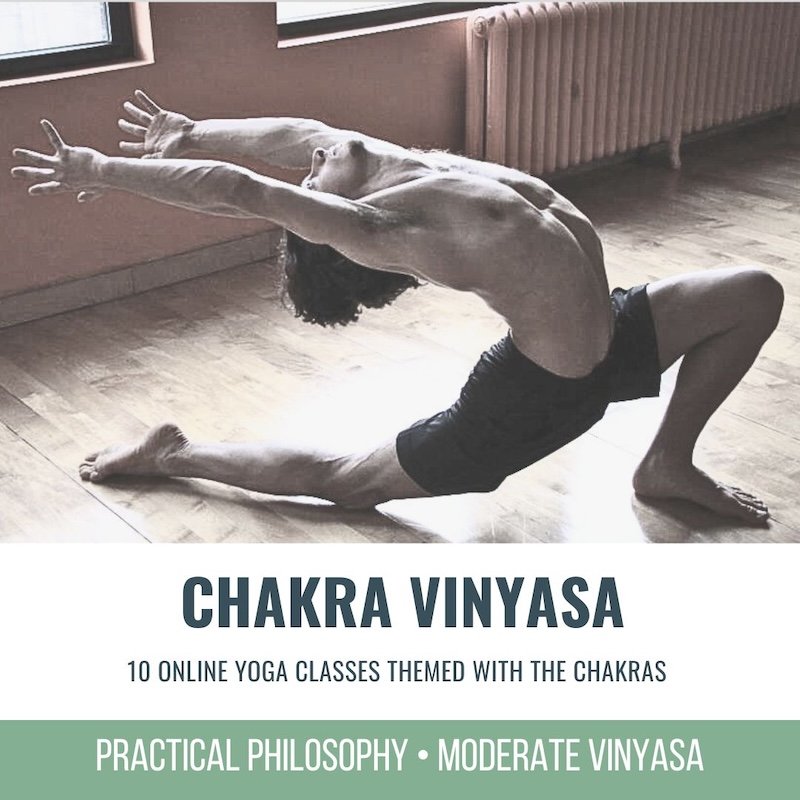
CHAKRA VINYASA

PRACTICAL PHILOSOPHY MODERATE VINYASA

  • 10 Chromatic Yoga practices with founder Matt Giordano
  • Inspirational and Practical Philosophy
  • Chakra Based Practices
  • ‘Physically Invigorating Yet Accessible
  • Breath Work for Energetic Realignment
  • Meditation for Clarity, Focus, and Grounding
  • Physically Well Rounded: All Postural Categories Will be Addressed
  • Designed as “Your Daily Yoga” 60 Minute Classes
  • Non-dogmatic, Anatomy informed Alignment
  • The Perfect Blend of Knowledge and Practice
  • Chromatic Slow Flow Style: Moderate Vinyasa Pacing Infused with Technique and Non-dogmatic Alignment
  • 10 Continuing Education hours with Yoga Alliance and American Yoga Council
  • 10 Accredited Practice Hours with the Chromatic School of Yoga
  • Step-by-Step instruction for increased accessibility
  • Sweat, Breath, Strengthen, Stretch and Feel Amazing!

SOLAR PLEXUS IN PLANK

Plank becomes a direct expression of awakening solar plexus strength when we stop avoiding the work. Matt says many of us lift the hips to make the posture easier, but instead we lower the pelvis slightly, tuck the tail, and draw the ribs back. The spine rounds gently, similar to cat pose, activating the deep core rather than relying on the hip flexors. As we lean forward and grip the ground, the upper back broadens and the body becomes more integrated. To balance this effort, we move into Bird Dog, by lifting opposite arm and leg. This creates an opposing pattern where extension meets control. It is not just about holding Plank. It is about understanding how the core stabilizes movement in multiple directions. Strength builds when we explore both contraction and expansion with intention.

WATCH THE VIDEO

AWAKENING SOLAR PLEXUS STRENGTH: FINDING TWO SIDES OF THE CORE

PLANK DRILL

Matt progresses this work through forearm plank variations. We begin on the knees, pulling the ribs back and keeping the hips low without lifting the pelvis. Once that connection is clear, we straighten the legs while maintaining the same shape. The tailbone stays tucked, the glutes engage, and the core draws inward. The elbows press down as the shoulder blades move apart. Each repetition reinforces awakening solar plexus strength by teaching us how to hold integrity under load. After each effort, we soften and release the abdomen, allowing the opposite action to restore balance. It is important for us to remember that strength is not built through constant tension alone. It develops through the ability to engage fully and then release with awareness.
200 Hour Online Teacher Training Certification

200 HOUR ONLINE TEACHER TRAINING

GET CERTIFIED & DEEPEN YOUR YOGA PRACTICE

  • Deepen your yoga practice
  • Build confidence speaking in front of groups in person and online
  • Learn foundational class structures and templates
  • Learn techniques for a wide range of yoga postures
  • Get certified and highly qualified to teach yoga
  • Yoga Alliance Globally Recognized Certification Program

BOAT POSE WITH FLEXED SPINE 

In boat pose, Matt shifts the familiar shape. Instead of lifting the chest high, we move into a flexed spine, drawing the knees tightly toward the chest. The arms wrap in to support the legs, or we hold the shape without assistance, extending the legs only as far as we can maintain connection. This creates a compact, rounded position where the core works deeply. The image becomes one of drawing inward rather than reaching outward. This contraction is what builds awakening solar plexus strength from within. To balance the intensity, we move into Reverse Tabletop, opening the front body and softening the abdomen. These opposing shapes remind us that strength and openness belong together. The body learns not only how to contract with purpose, but also how to release without losing control.
300 hour teacher training online

300 HOUR ONLINE TEACHER TRAINING

GET 500 HOUR CERTIFIED AS A MASTER TEACHER

Master your skill set as a teacher through refined techniques, anatomy, biomechanics, sequencing, philosophy, meditation techniques, theming, yoga business, and much more!

  • Get 500 hour certified
  • Learn anatomy, biomechanics, asana techniques
  • Expand your teaching skills
  • Masterful sequencing and verbal delivery
  • Learn meditation and breathwork techniques
  • Transformative tools: theming, dharma talks, satsang

BALANCING FIRE WITH AWARENESS

Balancing fire with awareness is what ultimately defines awakening solar plexus strength. Matt reminds us that this chakra represents our right to act, but also our responsibility to reflect on how we use that power. When we practice these core drills, we are not just building strength. We are learning how to navigate between effort and ease, between humility and assertion. The bowing forward of the body reflects humility, while lifting and engaging reflects strength. Together, they create a balanced centre. The solar plexus is not about dominating or shrinking. It is about responding appropriately to what is needed. As we refine these actions in our practice, we begin to carry that clarity into our lives, stepping into our power with intention, steadiness, and awareness.                      

Take the opportunity to step deeper into the awareness and totality of your practice by registering for Matt’s current online immersion Chakra Vinyasa.

The 200 Hr. Teacher Training: Click Here to See the Next Start Date

The 300 Hr. Advanced Teacher Training: Click Here to See the Next Start Date

Article by Trish Curling

Video Extracted From: Chakra Vinyasa Immersion
lotus pose online yoga classes

ONLINE ANATOMY COURSE

  • Accessible, exciting, and easy to learn
  • Anatomy and biomechanics for yoga
  • Appropriate for both teachers and students
  • Learn joint alignment vs pose alignment
  • Demystify yoga poses and transitions
  • Release aches and pains
  • Learn how to avoid common injuries
  • Caters to all levels with modifications and props
  • 20 hours Continued Education Credits with Yoga Alliance
  • 20 hours toward Chromatic Yoga Certification and 300 Hour
  • Lifetime access

Continue Learning

Hip Flexor Stretch Mechanics

Hip Flexor Stretch Mechanics

Hip Flexor Stretch MechanicsALIGNMENTHIP FLEXOR STRETCH MECHANICS Hip flexor stretch mechanics begins with understanding that stability and length often come from opposing actions. In the first demonstration, Matt cues the back inner thigh to lift upward, which tips...

read more
A Yoga Treatment For The Shoulders

A Yoga Treatment For The Shoulders

A Yoga Treatment For The ShouldersSTABILITYA YOGA TREATMENT FOR THE SHOULDERS Shoulders tend to speak up when stability is missing. Matt reminds us that building strength isn’t about aesthetics, it’s about support, resilience, and keeping the body working as one...
read more
Reverse Tabletop Strength

Reverse Tabletop Strength

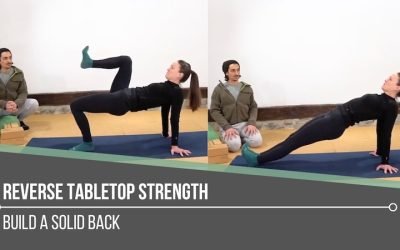
Reverse Tabletop StrengthMECHANICSREVERSE TABLETOP STRENGTH “Solid” implies strength,  yet in yoga, we can easily lose sight of how intentionally building the back body supports everything we do. Reverse Tabletop may look simple, but it asks a lot from the posterior...
read more
Focus On Eagle Pose Legs

Focus On Eagle Pose Legs

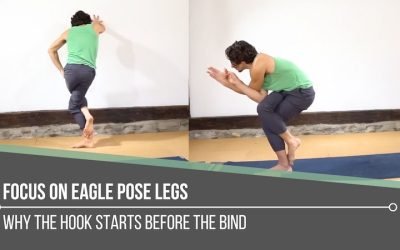
Focus On Eagle Pose LegsMECHANICSFOCUS ON EAGLE POSE LEGS When we focus on Eagle Pose legs, it’s tempting to assume the bind is a flexibility test. But this posture quietly reveals something more nuanced: timing, joint mechanics, and how efficiently the legs organize...
read more
Build Connection On The Mat

Build Connection On The Mat

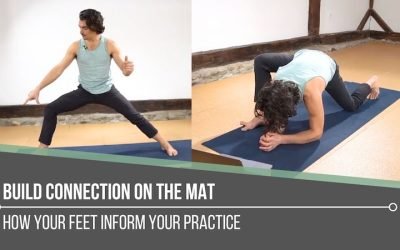
Build Connection On The MatGROUNDINGBUILD CONNECTION ON THE MAT Building connection on the mat starts at the place we tend to overlook: our feet. If we only practice the “shape” of a posture, we can miss the biomechanics that change how the whole pose feels from the...
read more
Flying Revolved Half Lotus

Flying Revolved Half Lotus

Flying Revolved Half LotusARM BALANCEFLYING REVOLVED HALF LOTUS Some postures don’t arrive through imitation; they arrive through investigation. Flying Revolved Half Lotus is one of those shapes. It borrows familiar ingredients like Side Crow mechanics, hip opening,...

read more

THE FREE TECHNIQUE PACK

When You Subscribe, You Will Get Instant Access to

  • the Technique Pack: 15 yoga pose breakdowns
  • exclusive online course discounts
  • exclusive blogs and videos
  • This field is for validation purposes and should be left unchanged.

Hip Flexor Stretch Mechanics

Hip Flexor Stretch Mechanics

ALIGNMENT

HIP FLEXOR STRETCH MECHANICS

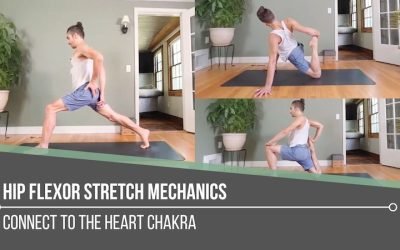
Hip flexor stretch mechanics begins with understanding that stability and length often come from opposing actions. In the first demonstration, Matt cues the back inner thigh to lift upward, which tips the pelvis slightly anterior. Against that motion, the front buttock scoops underneath. He explains that these actions seem to compete, yet they actually cooperate to organize the pelvis and protect the low back. As the back inner thigh lifts and reaches away, the front buttock gently presses down and under, while the front heel grounds into the floor. The result is a stable platform that allows the hip flexors to lengthen without collapsing the lumbar spine. When these mechanics work together, the stretch becomes more intentional and supportive rather than passive. Hip flexor stretch mechanics reminds us that thoughtful muscular engagement often unlocks the most sustainable mobility in our practice.

chromatic yoga 15 hour immersion

CHAKRA VINYASA

PRACTICAL PHILOSOPHY MODERATE VINYASA

  • 10 Chromatic Yoga practices with founder Matt Giordano
  • Inspirational and Practical Philosophy
  • Chakra Based Practices
  • ‘Physically Invigorating Yet Accessible
  • Breath Work for Energetic Realignment
  • Meditation for Clarity, Focus, and Grounding
  • Physically Well Rounded: All Postural Categories Will be Addressed
  • Designed as “Your Daily Yoga” 60 Minute Classes
  • Non-dogmatic, Anatomy informed Alignment
  • The Perfect Blend of Knowledge and Practice
  • Chromatic Slow Flow Style: Moderate Vinyasa Pacing Infused with Technique and Non-dogmatic Alignment
  • 10 Continuing Education hours with Yoga Alliance and American Yoga Council
  • 10 Accredited Practice Hours with the Chromatic School of Yoga
  • Step-by-Step instruction for increased accessibility
  • Sweat, Breath, Strengthen, Stretch and Feel Amazing!

TECHNIQUES IN HIGH LUNGE

In High Lunge, Matt refines these same mechanics. The back inner thigh continues to lift and reach backward while the front buttock scoops underneath to steady the pelvis. The heel presses firmly into the mat, reinforcing the length through the back leg. Once that base is organized, the arms reach upward and the chest lifts. Matt suggests gently drawing the abdomen upward, which cues the fascia to respond with a supportive lift through the front body. The low back moves slightly forward as the heart rises upward, creating space rather than compression. Hip flexor stretch mechanics becomes clearer here: the stretch deepens not because we sink further, but because the body organizes upward and outward simultaneously.

WATCH THE VIDEO

HIP FLEXOR STRETCH MECHANICS: CONNECT TO THE HEART CHAKRA

GET MORE FROM MONKEY POSE

When transitioning toward Monkey Pose, Matt keeps the same principles intact. The pelvis continues to balance between the lifting back inner thigh and the grounding action of the front leg. Even as the legs lengthen apart, the focus remains on maintaining structure rather than chasing range. By pressing through the heel and stabilizing the hips, the stretch distributes evenly through the hip flexors and hamstrings. This approach ensures the spine remains supported while the legs explore deeper length. Hip Flexor Stretch Mechanics shows that Monkey Pose becomes more productive when the pelvis remains organized and the legs maintain active participation rather than simply sliding into flexibility.

200 Hour Online Teacher Training Certification

200 HOUR ONLINE TEACHER TRAINING

GET CERTIFIED & DEEPEN YOUR YOGA PRACTICE

  • Deepen your yoga practice
  • Build confidence speaking in front of groups in person and online
  • Learn foundational class structures and templates
  • Learn techniques for a wide range of yoga postures
  • Get certified and highly qualified to teach yoga
  • Yoga Alliance Globally Recognized Certification Program

LENGTH IN ANJANEYASANA 

Length in Anjaneyasana evolves through an added thigh stretch. Matt guides us to bend the back knee and reach for the foot, gently kicking the foot into the hand to activate the quadriceps. The hand resists lightly while the foot presses back with about twenty percent effort. This creates a facilitated stretch rather than a passive pull. As the torso lifts and the abdomen opens, the quads stay engaged and the chest expands. The back knee can subtly pull forward while the foot presses backward into the hand, intensifying the hip flexor length safely. Hip Flexor Stretch Mechanics becomes clearer here: by activating both sides of the joint, the body finds more support and depth without strain.

300 hour teacher training online

300 HOUR ONLINE TEACHER TRAINING

GET 500 HOUR CERTIFIED AS A MASTER TEACHER

Master your skill set as a teacher through refined techniques, anatomy, biomechanics, sequencing, philosophy, meditation techniques, theming, yoga business, and much more!

  • Get 500 hour certified
  • Learn anatomy, biomechanics, asana techniques
  • Expand your teaching skills
  • Masterful sequencing and verbal delivery
  • Learn meditation and breathwork techniques
  • Transformative tools: theming, dharma talks, satsang

CONNECTION TO THE HEART

Connection to the Heart emerges naturally from these mechanics. Matt reminds us that the heart chakra is associated with softness, compassion, and connection beyond the individual self. In this posture, the belly remains soft while the heart lifts upward. That softness allows the front body to open without forcing the stretch. The heart chakra is often described as the bridge between the lower and upper centers of the body, connecting physical grounding with more expansive awareness. As the hip flexors lengthen and the chest opens, the posture invites a broader perspective. Instead of striving for a deeper stretch alone, the practice encourages openness and receptivity. Hip flexor stretch mechanics ultimately supports this idea: when the body organizes with balance and intention, the heart has space to rise and connect outward.

Register for Matt’s upcomiong online yoga immersion Chakra Vinyasa to unveil another layer of your practice. 

The 200 Hr. Teacher Training: Click Here to See the Next Start Date

The 300 Hr. Advanced Teacher Training: Click Here to See the Next Start Date

Article by Trish Curling

Video Extracted From: Chakras & The Elements Immersion

lotus pose online yoga classes

ONLINE ANATOMY COURSE

  • Accessible, exciting, and easy to learn
  • Anatomy and biomechanics for yoga
  • Appropriate for both teachers and students
  • Learn joint alignment vs pose alignment
  • Demystify yoga poses and transitions
  • Release aches and pains
  • Learn how to avoid common injuries
  • Caters to all levels with modifications and props
  • 20 hours Continued Education Credits with Yoga Alliance
  • 20 hours toward Chromatic Yoga Certification and 300 Hour
  • Lifetime access

Continue Learning

Hip Flexor Stretch Mechanics

Hip Flexor Stretch Mechanics

Hip Flexor Stretch MechanicsALIGNMENTHIP FLEXOR STRETCH MECHANICS Hip flexor stretch mechanics begins with understanding that stability and length often come from opposing actions. In the first demonstration, Matt cues the back inner thigh to lift upward, which tips...

read more
A Yoga Treatment For The Shoulders

A Yoga Treatment For The Shoulders

A Yoga Treatment For The ShouldersSTABILITYA YOGA TREATMENT FOR THE SHOULDERS Shoulders tend to speak up when stability is missing. Matt reminds us that building strength isn’t about aesthetics, it’s about support, resilience, and keeping the body working as one...

read more
Reverse Tabletop Strength

Reverse Tabletop Strength

Reverse Tabletop StrengthMECHANICSREVERSE TABLETOP STRENGTH “Solid” implies strength,  yet in yoga, we can easily lose sight of how intentionally building the back body supports everything we do. Reverse Tabletop may look simple, but it asks a lot from the posterior...

read more
Focus On Eagle Pose Legs

Focus On Eagle Pose Legs

Focus On Eagle Pose LegsMECHANICSFOCUS ON EAGLE POSE LEGS When we focus on Eagle Pose legs, it’s tempting to assume the bind is a flexibility test. But this posture quietly reveals something more nuanced: timing, joint mechanics, and how efficiently the legs organize...

read more
Build Connection On The Mat

Build Connection On The Mat

Build Connection On The MatGROUNDINGBUILD CONNECTION ON THE MAT Building connection on the mat starts at the place we tend to overlook: our feet. If we only practice the “shape” of a posture, we can miss the biomechanics that change how the whole pose feels from the...

read more
Flying Revolved Half Lotus

Flying Revolved Half Lotus

Flying Revolved Half LotusARM BALANCEFLYING REVOLVED HALF LOTUS Some postures don’t arrive through imitation; they arrive through investigation. Flying Revolved Half Lotus is one of those shapes. It borrows familiar ingredients like Side Crow mechanics, hip opening,...

read more

THE FREE TECHNIQUE PACK

When You Subscribe, You Will Get Instant Access to

  • the Technique Pack: 15 yoga pose breakdowns
  • exclusive online course discounts
  • exclusive blogs and videos
  • This field is for validation purposes and should be left unchanged.

A Yoga Treatment For The Shoulders

A Yoga Treatment For The Shoulders

STABILITY

A YOGA TREATMENT FOR THE SHOULDERS

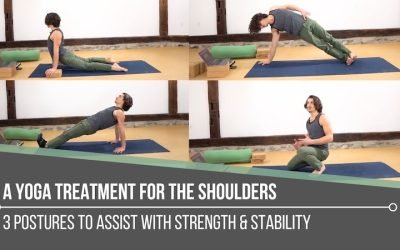
Shoulders tend to speak up when stability is missing. Matt reminds us that building strength isn’t about aesthetics, it’s about support, resilience, and keeping the body working as one integrated system. This practice becomes a yoga treatment for the shoulders by addressing vulnerability with intelligent loading and clear mechanics. What looks simple on the surface asks us to organize the back body, refine scapular placement, and strengthen the muscles that hold us upright. Reverse plank becomes our entry point, activating the rear deltoids, triceps, and upper back while teaching the shoulder heads to roll back into safer alignment. Instead of chasing stretch, we build structure.  When structure improves, health follows, because strong shoulders don’t just move better, they stabilize everything above and below them.

chromatic yoga 15 hour immersion

YOGA FOR STRENGTH

YOGA ASANA, CALISTHENICS,  BODY WEIGHT TRAINING

  • 8 Chromatic Yoga practices with founder Matt Giordano
  • Physically Invigorating Yet Accessible
  • Calisthenics and Body Weight Training For Improved Strength and Functionality
  • Improve Joint Integrity, Mobility, Balance, Stability, and Muscular Health
  • All Major Movement Joints
  • Designed as “Your Daily Yoga” 60 Minute Classes
  • Non-dogmatic, Anatomy informed Alignment
  • The Perfect Blend of Knowledge and Practice
  • Chromatic Slow Flow Style: Moderate Vinyasa Pacing Infused with Technique and Non-dogmatic Alignment
  • 8 Continuing Education hours with Yoga Alliance and American Yoga Council
  • 8 Accredited Practice Hours with the Chromatic School of Yoga
  • Step-by-Step instruction for increased accessibility
  • Sweat, Breath, Strengthen, Stretch and Feel Amazing!

TARGET THE REAR DELTOIDS

From Reverse Plank, Matt directs us to internally rotate the arms while rolling the shoulder heads back, immediately waking up the posterior shoulder fibers. Pressing the hands down and back engages the triceps and rear deltoids, creating shoulder extension while drawing the shoulder blades toward each other. This is the opposite muscle pattern of plank and that contrast is a vital tool. As hips lift, we actively retract the scapula and feel the back body participate. This portion of a yoga treatment for the shoulders teaches us how pushing backward through the arms creates support through the upper spine. It’s not passive holding, it’s intentional effort that conditions the muscles behind the shoulders to carry load, preparing us for deeper backbends and arm-supported shapes later.

WATCH THE VIDEO

A YOGA TREATMENT FOR THE SHOULDERS: 3 POSTURES TO ASSIST WITH STRENGTH & STABILITY

UPWARD FACING DOG MINI WORKSHOP

Before full Upward Dog, Matt slows everything down. Using blocks, we rehearse shoulder alignment first: shrug up, roll back, then press down through the hands while keeping the chest moving forward. That downward press lights up the posterior shoulders, triceps, and muscles between the shoulder blades. Only then do we add spinal extension. When we move into Upward Dog, knees start further forward so weight transfers clearly into the hands. Pulling the blocks back draws the chest through, lifting the heart without collapsing into the lower back. This phase of a yoga treatment for the shoulders teaches us that Upward Dog isn’t about hanging in flexibility, it’s about pressing, organizing, and letting the shoulders guide safe spinal lift.

200 Hour Online Teacher Training Certification

200 HOUR ONLINE TEACHER TRAINING

GET CERTIFIED & DEEPEN YOUR YOGA PRACTICE

  • Deepen your yoga practice
  • Build confidence speaking in front of groups in person and online
  • Learn foundational class structures and templates
  • Learn techniques for a wide range of yoga postures
  • Get certified and highly qualified to teach yoga
  • Yoga Alliance Globally Recognized Certification Program

ISOMETRIC ROTATIONS

Side plank introduces opposing actions that stabilize the rotator cuff. Matt cues us to externally rotate the upper arm until the shoulder head rolls back, then internally rotate against that action without moving, creating an isometric lock. This co-contraction keeps the joint centered while we push through the hand and stack the feet. The power originates at the scapula and travels through the arm into the palm. He also reminds us to stay engaged as we exit poses, releasing effort only once weight is gone.  This is a key injury prevention habit. These isometric rotations complete a yoga treatment for the shoulders, teaching us how opposing muscle groups work together to protect the joint under load.

300 hour teacher training online

300 HOUR ONLINE TEACHER TRAINING

GET 500 HOUR CERTIFIED AS A MASTER TEACHER

Master your skill set as a teacher through refined techniques, anatomy, biomechanics, sequencing, philosophy, meditation techniques, theming, yoga business, and much more!

  • Get 500 hour certified
  • Learn anatomy, biomechanics, asana techniques
  • Expand your teaching skills
  • Masterful sequencing and verbal delivery
  • Learn meditation and breathwork techniques
  • Transformative tools: theming, dharma talks, satsang

STABILITY YOU CAN CARRY FORWARD

What ties this practice together is awareness under effort. From reverse plank to Upward Dog to side plank, Matt shows us how deliberate activation builds lasting support. Rear deltoids, triceps, rotator cuff, and scapular stabilizers all learn to share responsibility instead of leaving the shoulders vulnerable. This is why framing these actions as a yoga treatment for the shoulders works. It trains coordination, not just muscles. As Matt demonstrates each drill, we see how structure creates freedom: shoulders roll back, hearts lift, and strength becomes functional. These aren’t isolated exercises, they’re transferable skills that show up in backbends, arm balances, and everyday posture. When we move with intention, the shoulders stop compensating and start cooperating.

If you missed it, you can still access Matt’s recent online yoga immersion Yoga For Strength.  Get lifetime access here.


The 200 Hr. Teacher Training: Click Here to See the Next Start Date

The 300 Hr. Advanced Teacher Training: Click Here to See the Next Start Date

Article by Trish Curling

Video Extracted From: Yoga For Strength Immersion

lotus pose online yoga classes

ONLINE ANATOMY COURSE

  • Accessible, exciting, and easy to learn
  • Anatomy and biomechanics for yoga
  • Appropriate for both teachers and students
  • Learn joint alignment vs pose alignment
  • Demystify yoga poses and transitions
  • Release aches and pains
  • Learn how to avoid common injuries
  • Caters to all levels with modifications and props
  • 20 hours Continued Education Credits with Yoga Alliance
  • 20 hours toward Chromatic Yoga Certification and 300 Hour
  • Lifetime access

Continue Learning

Hip Flexor Stretch Mechanics

Hip Flexor Stretch Mechanics

Hip Flexor Stretch MechanicsALIGNMENTHIP FLEXOR STRETCH MECHANICS Hip flexor stretch mechanics begins with understanding that stability and length often come from opposing actions. In the first demonstration, Matt cues the back inner thigh to lift upward, which tips...

read more
A Yoga Treatment For The Shoulders

A Yoga Treatment For The Shoulders

A Yoga Treatment For The ShouldersSTABILITYA YOGA TREATMENT FOR THE SHOULDERS Shoulders tend to speak up when stability is missing. Matt reminds us that building strength isn’t about aesthetics, it’s about support, resilience, and keeping the body working as one...

read more
Reverse Tabletop Strength

Reverse Tabletop Strength

Reverse Tabletop StrengthMECHANICSREVERSE TABLETOP STRENGTH “Solid” implies strength,  yet in yoga, we can easily lose sight of how intentionally building the back body supports everything we do. Reverse Tabletop may look simple, but it asks a lot from the posterior...

read more
Focus On Eagle Pose Legs

Focus On Eagle Pose Legs

Focus On Eagle Pose LegsMECHANICSFOCUS ON EAGLE POSE LEGS When we focus on Eagle Pose legs, it’s tempting to assume the bind is a flexibility test. But this posture quietly reveals something more nuanced: timing, joint mechanics, and how efficiently the legs organize...

read more
Build Connection On The Mat

Build Connection On The Mat

Build Connection On The MatGROUNDINGBUILD CONNECTION ON THE MAT Building connection on the mat starts at the place we tend to overlook: our feet. If we only practice the “shape” of a posture, we can miss the biomechanics that change how the whole pose feels from the...

read more
Flying Revolved Half Lotus

Flying Revolved Half Lotus

Flying Revolved Half LotusARM BALANCEFLYING REVOLVED HALF LOTUS Some postures don’t arrive through imitation; they arrive through investigation. Flying Revolved Half Lotus is one of those shapes. It borrows familiar ingredients like Side Crow mechanics, hip opening,...

read more

THE FREE TECHNIQUE PACK

When You Subscribe, You Will Get Instant Access to

  • the Technique Pack: 15 yoga pose breakdowns
  • exclusive online course discounts
  • exclusive blogs and videos
  • This field is for validation purposes and should be left unchanged.

Focus On Eagle Pose Legs

Focus On Eagle Pose Legs

MECHANICS

FOCUS ON EAGLE POSE LEGS

When we focus on Eagle Pose legs, it’s tempting to assume the bind is a flexibility test. But this posture quietly reveals something more nuanced: timing, joint mechanics, and how efficiently the legs organize around one another. The wrap isn’t forced by range alone; it emerges when the thigh rotates, the ankle everts strategically, and the pelvis cooperates. Eversion of the ankle in Chromatic yoga, is an action that is paired with internal rotation of the thigh.

Matt reframes Eagle as a coordination study. Internal rotation of the top thigh allows the leg to spiral closer, while the adductors stabilize the midline so the action doesn’t collapse. The hook of the foot is secondary. What matters is functionality and how the body learns to move in the right direction with intention. When mechanics lead, the shape often follows.

chromatic yoga 15 hour immersion

YOGA FOR STRENGTH

YOGA ASANA, CALISTHENICS,  BODY WEIGHT TRAINING

  • 8 Chromatic Yoga practices with founder Matt Giordano
  • Physically Invigorating Yet Accessible
  • Calisthenics and Body Weight Training For Improved Strength and Functionality
  • Improve Joint Integrity, Mobility, Balance, Stability, and Muscular Health
  • All Major Movement Joints
  • Designed as “Your Daily Yoga” 60 Minute Classes
  • Non-dogmatic, Anatomy informed Alignment
  • The Perfect Blend of Knowledge and Practice
  • Chromatic Slow Flow Style: Moderate Vinyasa Pacing Infused with Technique and Non-dogmatic Alignment
  • 8 Continuing Education hours with Yoga Alliance and American Yoga Council
  • 8 Accredited Practice Hours with the Chromatic School of Yoga
  • Step-by-Step instruction for increased accessibility
  • Sweat, Breath, Strengthen, Stretch and Feel Amazing!

SUPINE EAGLE

Practicing Eagle legs supine removes balance demands so we can study the mechanics clearly. As the top ankle inverts, the thigh externally rotates—often pushing the legs apart instead of drawing them together. To counter this, the thigh bone must internally rotate, allowing the top leg to “climb” closer to the standing leg.  This action becomes more natural when we evert the ankle.  In the video, we see how quickly internal rotation of the thigh bone occurs when eversion of the ankle occurs.

This is where the adductors also come online. They help guide the legs toward one another while the pelvis subtly hikes to create space. The foot may evert in an attempt to hook, but the goal isn’t the hook itself, it’s learning the pathway. Even without full range, moving in the correct direction trains coordination. Supine work makes it obvious: functionality matters more than how dramatic the wrap looks.

WATCH THE VIDEO

FOCUS ON EAGLE POSE LEGS: WHY THE HOOK STARTS BEFORE THE BIND

MECHANICS AT THE WALL

The wall becomes a teacher when we focus on Eagle Pose legs upright. Using one hand on the wall for support allows the top leg to wrap with better timing and less strain. Facing the chest toward the wall encourages internal rotation of the top thigh while the foot everts behind the calf.

Here, momentum plays a role.  Matt reminds us that it’s not speed, but rather a smooth, wave-like action. Moving too slowly often makes the wrap harder, not easier, because the mechanics stall. A controlled flow allows the joints to coordinate in sequence. The wall also lets us turn away and sit once the legs are organized, reinforcing that the wrap is built before depth is added. Stability first, then shape.

200 Hour Online Teacher Training Certification

200 HOUR ONLINE TEACHER TRAINING

GET CERTIFIED & DEEPEN YOUR YOGA PRACTICE

  • Deepen your yoga practice
  • Build confidence speaking in front of groups in person and online
  • Learn foundational class structures and templates
  • Learn techniques for a wide range of yoga postures
  • Get certified and highly qualified to teach yoga
  • Yoga Alliance Globally Recognized Certification Program

FREE STANDING EAGLE

Away from the wall, the same principles apply. A kickstand with a yoga block is optional, but even with support, the ankle still everts with intention. The standing foot shortens, the big toe reaches forward, and the pinky toe draws back, creating a responsive base.

Again, a small amount of momentum (never force) helps the legs find their pathway. Once wrapped, sitting lower invites the adductors to stabilize while the tailbone tucks to lock the system in place. Free-standing Eagle reminds us that balance improves when mechanics are respected, not rushed.

300 hour teacher training online

300 HOUR ONLINE TEACHER TRAINING

GET 500 HOUR CERTIFIED AS A MASTER TEACHER

Master your skill set as a teacher through refined techniques, anatomy, biomechanics, sequencing, philosophy, meditation techniques, theming, yoga business, and much more!

  • Get 500 hour certified
  • Learn anatomy, biomechanics, asana techniques
  • Expand your teaching skills
  • Masterful sequencing and verbal delivery
  • Learn meditation and breathwork techniques
  • Transformative tools: theming, dharma talks, satsang

LET THE ACTIONS DO THE WORK

Eagle Pose doesn’t ask for perfection, it respectfully invites participation. When we focus on Eagle Pose legs, the wrap becomes a conversation between ankle mechanics, thigh rotation, pelvic positioning, and adductor strength. The foot hook is simply one possible outcome, not the goal.

By letting actions lead instead of forcing range, the body learns how to organize efficiently. Over time, the bind may appear more easily, but even if it doesn’t, the nervous system has learned something valuable. Eagle becomes more accessible,  not because we pushed harder, but because we listened better.

Learn more about the skills involved in mechanics, functionality and strength of how we move in our asana practice in Matt’s upcoming online immersion Yoga For Strength

The 200 Hr. Teacher Training: Click Here to See the Next Start Date

The 300 Hr. Advanced Teacher Training: Click Here to See the Next Start Date

Article by Trish Curling

Video Extracted From: Slow Flow & Go Immersion

lotus pose online yoga classes

ONLINE ANATOMY COURSE

  • Accessible, exciting, and easy to learn
  • Anatomy and biomechanics for yoga
  • Appropriate for both teachers and students
  • Learn joint alignment vs pose alignment
  • Demystify yoga poses and transitions
  • Release aches and pains
  • Learn how to avoid common injuries
  • Caters to all levels with modifications and props
  • 20 hours Continued Education Credits with Yoga Alliance
  • 20 hours toward Chromatic Yoga Certification and 300 Hour
  • Lifetime access

Continue Learning

Hip Flexor Stretch Mechanics

Hip Flexor Stretch Mechanics

Hip Flexor Stretch MechanicsALIGNMENTHIP FLEXOR STRETCH MECHANICS Hip flexor stretch mechanics begins with understanding that stability and length often come from opposing actions. In the first demonstration, Matt cues the back inner thigh to lift upward, which tips...

read more
A Yoga Treatment For The Shoulders

A Yoga Treatment For The Shoulders

A Yoga Treatment For The ShouldersSTABILITYA YOGA TREATMENT FOR THE SHOULDERS Shoulders tend to speak up when stability is missing. Matt reminds us that building strength isn’t about aesthetics, it’s about support, resilience, and keeping the body working as one...

read more
Reverse Tabletop Strength

Reverse Tabletop Strength

Reverse Tabletop StrengthMECHANICSREVERSE TABLETOP STRENGTH “Solid” implies strength,  yet in yoga, we can easily lose sight of how intentionally building the back body supports everything we do. Reverse Tabletop may look simple, but it asks a lot from the posterior...

read more
Focus On Eagle Pose Legs

Focus On Eagle Pose Legs

Focus On Eagle Pose LegsMECHANICSFOCUS ON EAGLE POSE LEGS When we focus on Eagle Pose legs, it’s tempting to assume the bind is a flexibility test. But this posture quietly reveals something more nuanced: timing, joint mechanics, and how efficiently the legs organize...

read more
Build Connection On The Mat

Build Connection On The Mat

Build Connection On The MatGROUNDINGBUILD CONNECTION ON THE MAT Building connection on the mat starts at the place we tend to overlook: our feet. If we only practice the “shape” of a posture, we can miss the biomechanics that change how the whole pose feels from the...

read more
Flying Revolved Half Lotus

Flying Revolved Half Lotus

Flying Revolved Half LotusARM BALANCEFLYING REVOLVED HALF LOTUS Some postures don’t arrive through imitation; they arrive through investigation. Flying Revolved Half Lotus is one of those shapes. It borrows familiar ingredients like Side Crow mechanics, hip opening,...

read more

THE FREE TECHNIQUE PACK

When You Subscribe, You Will Get Instant Access to

  • the Technique Pack: 15 yoga pose breakdowns
  • exclusive online course discounts
  • exclusive blogs and videos
  • This field is for validation purposes and should be left unchanged.

Flying Revolved Half Lotus

Flying Revolved Half Lotus

ARM BALANCE

FLYING REVOLVED HALF LOTUS

Some postures don’t arrive through imitation; they arrive through investigation. Flying Revolved Half Lotus is one of those shapes. It borrows familiar ingredients like Side Crow mechanics, hip opening, Janu Sirsasana–style leg positioning, spinal rotation, and the essential arm-balance actions of leaning, resisting, and pushing. It also demands strong scapular protraction and a willingness to stay curious rather than chase something predefined. In the full class, Matt shared that this pose wasn’t something he was necessarily taught, but rather that it emerged through exploration, asking how known shapes could reorganize into something new. In many ways, Flying Revolved Half Lotus can feel more approachable than Flying Full Lotus because it allows the hips to work asymmetrically. Instead of forcing symmetry, we learn to manage rotation, weight distribution, and balance through intelligent setup piece by piece – the Chromatic way of course.

chromatic yoga 15 hour immersion

FLYING HIP OPENERS

ASANA INFUSED WITH STEP BY STEP TECHNIQUES FOR ARM BALANCES

  • 10 Chromatic Yoga practices with founder Matt Giordano
  • Physically Invigorating
  • Foundations, Refinement and Advancement
  • Meticulously Crafted Experiences to Set you up for Maximum Success
  • Included Postures: Crow, Side Crow, Firefly, Dragon Fly, Revolved Flying Half Lotus, Koundenyasana 1 & 2, Hybrid Arm Balances, Straddle Handstand and More
  • 12+ Arm Balances with Modifications and Variations!
  • Hip Opening Techniques, Core Strength, Wrist Strength and Mobility
  • All Levels Appropriate Full length 75 minute Classes
  • Non-dogmatic, Anatomy informed Alignment
  • The Perfect Blend of Knowledge and Practice
  • A Heavy Emphasis on Technique for the Poses Everyone Expects You to Know but Non One Teaches
  • 12 Continuing Education hours with Yoga Alliance and American Yoga Council
  • 12 Accredited Practice Hours with the Chromatic School of Yoga
  • Step-by-Step instruction for increased accessibility
  • Sweat, Breath, Strengthen, Stretch and Feel Amazing!

PIGEON IS IMPORTANT

We begin in a lifted pigeon preparation, with the right shin across the mat and the legs staying active rather than sinking into flexibility. Matt cues us to pull the pelvis back by reaching strongly through the back heel, creating length and tone at the same time. From here, the twist becomes the priority. We flex the spine and rotate, placing the left elbow down while the right hand actively pushes the torso away from the front thigh. This push-and-reach dynamic creates space for rotation rather than collapsing into it. The left arm reaches to deepen the twist while the right hand provides resistance, keeping the body buoyant and supported. Although the stretch is deep, the strength in the legs keeps us organized. This phase establishes the rotational blueprint we’ll later need when gravity becomes part of the equation.

WATCH THE VIDEO

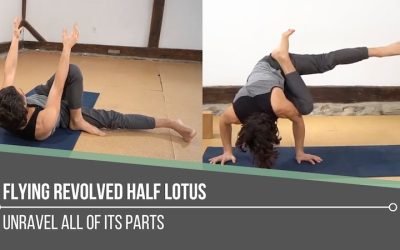
FLYING REVOLVED HALF LOTUS: UNRAVEL ALL OF ITS PARTS

SIDE CROW IS VITAL

Before taking flight, we return to something familiar: Side Crow. Matt instructs us that any variation works, as long as the pelvis isn’t resting passively on the opposite elbow. Matt emphasizes lining the knee up outside the elbow so the load transfers cleanly through the arms. Whether squeezing a block between the shins, pulling a strap apart, or keeping one foot grounded, the goal is the same, which is to lean forward, grip the ground, and hold. This isn’t about how long we balance, but about imprinting the arm-balance mechanics that Flying Revolved Half Lotus depends on. Protraction, finger grip, and forward lean all get rehearsed here. Side Crow becomes the structural anchor of the pose, reminding us how rotation and balance coexist without one overpowering the other.

200 Hour Online Teacher Training Certification

200 HOUR ONLINE TEACHER TRAINING

GET CERTIFIED & DEEPEN YOUR YOGA PRACTICE

  • Deepen your yoga practice
  • Build confidence speaking in front of groups in person and online
  • Learn foundational class structures and templates
  • Learn techniques for a wide range of yoga postures
  • Get certified and highly qualified to teach yoga
  • Yoga Alliance Globally Recognized Certification Program

THE INITIAL SHAPE

Next, Matt brings us back to the floor to “imprint the experience.” With the left foot grounded and the right leg extended or bent, we sit up and lower down repeatedly, flexing and rotating the spine. This sit-up pattern mimics the core engagement and twisting effort of the final pose without the pressure of balancing. Holding the shape briefly lets the nervous system recognize it as familiar. From here, we might explore a standing variation that draws the knee tightly across the body, echoing the half-lotus pathway. Hands hover as if preparing for Side Crow, knees stay compact, and we subtly wiggle to find alignment. This phase isn’t flashy, but it’s essential. It’s where the body learns the shape before being asked to support it.

300 hour teacher training online

300 HOUR ONLINE TEACHER TRAINING

GET 500 HOUR CERTIFIED AS A MASTER TEACHER

Master your skill set as a teacher through refined techniques, anatomy, biomechanics, sequencing, philosophy, meditation techniques, theming, yoga business, and much more!

  • Get 500 hour certified
  • Learn anatomy, biomechanics, asana techniques
  • Expand your teaching skills
  • Masterful sequencing and verbal delivery
  • Learn meditation and breathwork techniques
  • Transformative tools: theming, dharma talks, satsang

READY TO GO

When all the pieces come together, the transition feels deliberate rather than rushed. We move the knees slightly to create space for the elbow, place the hands wide, and lean forward and slightly sideways. One knee presses down as the other draws inward, creating opposition that stabilizes the lift. Matt demonstrates options here, reminding us that Flying Revolved Half Lotus isn’t about forcing elevation, it’s about honoring the setup. Whether we lift fully or hover with control, the work has already been done. The hips understand their role, the arms know how to support, and the spine rotates with clarity. At this point, the pose isn’t mysterious, it’s simply a conversation between familiar actions, organized with intention.

Matt finished off 2025 with strength in his Flying Hip Openers Immersion.  Did you miss it?  You can still register for all of the lifetime replays here.

The 200 Hr. Teacher Training: Click Here to See the Next Start Date

The 300 Hr. Advanced Teacher Training: Click Here to See the Next Start Date

Article by Trish Curling

Video Extracted From: Flying Hip Openers Immersion

lotus pose online yoga classes

ONLINE ANATOMY COURSE

  • Accessible, exciting, and easy to learn
  • Anatomy and biomechanics for yoga
  • Appropriate for both teachers and students
  • Learn joint alignment vs pose alignment
  • Demystify yoga poses and transitions
  • Release aches and pains
  • Learn how to avoid common injuries
  • Caters to all levels with modifications and props
  • 20 hours Continued Education Credits with Yoga Alliance
  • 20 hours toward Chromatic Yoga Certification and 300 Hour
  • Lifetime access

Continue Learning

Hip Flexor Stretch Mechanics

Hip Flexor Stretch Mechanics

Hip Flexor Stretch MechanicsALIGNMENTHIP FLEXOR STRETCH MECHANICS Hip flexor stretch mechanics begins with understanding that stability and length often come from opposing actions. In the first demonstration, Matt cues the back inner thigh to lift upward, which tips...

read more
A Yoga Treatment For The Shoulders

A Yoga Treatment For The Shoulders

A Yoga Treatment For The ShouldersSTABILITYA YOGA TREATMENT FOR THE SHOULDERS Shoulders tend to speak up when stability is missing. Matt reminds us that building strength isn’t about aesthetics, it’s about support, resilience, and keeping the body working as one...

read more
Reverse Tabletop Strength

Reverse Tabletop Strength

Reverse Tabletop StrengthMECHANICSREVERSE TABLETOP STRENGTH “Solid” implies strength,  yet in yoga, we can easily lose sight of how intentionally building the back body supports everything we do. Reverse Tabletop may look simple, but it asks a lot from the posterior...

read more
Focus On Eagle Pose Legs

Focus On Eagle Pose Legs

Focus On Eagle Pose LegsMECHANICSFOCUS ON EAGLE POSE LEGS When we focus on Eagle Pose legs, it’s tempting to assume the bind is a flexibility test. But this posture quietly reveals something more nuanced: timing, joint mechanics, and how efficiently the legs organize...

read more
Build Connection On The Mat

Build Connection On The Mat

Build Connection On The MatGROUNDINGBUILD CONNECTION ON THE MAT Building connection on the mat starts at the place we tend to overlook: our feet. If we only practice the “shape” of a posture, we can miss the biomechanics that change how the whole pose feels from the...

read more
Flying Revolved Half Lotus

Flying Revolved Half Lotus

Flying Revolved Half LotusARM BALANCEFLYING REVOLVED HALF LOTUS Some postures don’t arrive through imitation; they arrive through investigation. Flying Revolved Half Lotus is one of those shapes. It borrows familiar ingredients like Side Crow mechanics, hip opening,...

read more

THE FREE TECHNIQUE PACK

When You Subscribe, You Will Get Instant Access to

  • the Technique Pack: 15 yoga pose breakdowns
  • exclusive online course discounts
  • exclusive blogs and videos
  • This field is for validation purposes and should be left unchanged.

Pin It on Pinterest